
If you’ve started a GLP-1 and hormone replacement therapy journey and found that one is working better than the other — or neither is working as well as you hoped — you’re not alone. Millions of patients are discovering that these two powerful treatments don’t just coexist; they amplify each other in ways that neither can achieve alone.
The intersection of GLP-1 medications and hormone replacement therapy (HRT and TRT) is one of the most exciting frontiers in metabolic medicine right now — and one of the most misunderstood. At Telomere-Connexus Clinic in Mobile, AL, we use advanced diagnostic testing to help patients determine the right combination, sequencing, and dosing for their individual biology. Here’s what the science says, and what you need to know before combining these two powerful therapies.
What GLP-1 Medications Actually Do (Beyond Appetite Suppression)
Most people know GLP-1 receptor agonists — semaglutide or tirzepatide — as “weight loss shots.” But these medications do far more than curb your appetite.
GLP-1 stands for glucagon-like peptide-1, a hormone your gut naturally produces in response to food. GLP-1 medications mimic this hormone and work through several mechanisms:
- Slowing gastric emptying, so you feel full longer after eating
- Acting on the brain’s reward and satiety centers, reducing cravings and food noise
- Improving insulin sensitivity, helping your body use glucose more efficiently
- Reducing inflammation, which has downstream effects on metabolic health
- Promoting fat oxidation, particularly visceral (abdominal) fat
Tirzepatide goes a step further as a dual GIP/GLP-1 agonist, also activating glucose-dependent insulinotropic polypeptide receptors — which improves insulin sensitivity and fat metabolism through an additional pathway. Research from the Endocrine Society continues to expand our understanding of how these mechanisms interact with the broader hormonal environment.
But here’s what GLP-1 medications don’t do on their own: they don’t address the underlying hormonal environment that may be driving metabolic dysfunction in the first place. That’s where our medical weight loss program takes a more complete approach.
Where Hormones Enter the Picture
Hormones govern virtually every aspect of metabolism. Testosterone, estrogen, and progesterone don’t just influence mood and libido — they directly regulate how your body stores fat, builds muscle, responds to insulin, and burns calories at rest.
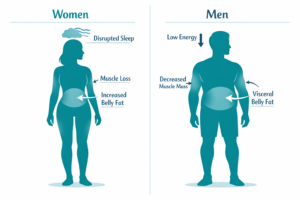
For Women: Estrogen, Menopause, and Metabolic Health
As estrogen declines during perimenopause and menopause, several metabolic shifts occur simultaneously:
- Fat redistributes from hips and thighs to the abdomen (visceral fat)
- Insulin sensitivity worsens, making blood sugar harder to regulate
- Resting metabolic rate decreases, meaning you burn fewer calories at rest
- Muscle mass declines, further lowering your baseline metabolism
- Sleep quality degrades, which elevates cortisol and drives fat storage
These aren’t character flaws or lack of willpower — they’re physiological changes driven by hormonal decline. The North American Menopause Society recognizes these metabolic shifts as a central challenge of the menopause transition. They make weight loss significantly harder, even with dietary discipline. Our hormone replacement therapy for women is designed to address this root cause directly.
For Men: Testosterone and Body Composition
Low testosterone (hypogonadism) produces a strikingly similar metabolic picture in men:
- Increased visceral fat accumulation, particularly around the abdomen
- Loss of lean muscle mass, which directly reduces metabolic rate
- Declining insulin sensitivity, raising type 2 diabetes risk
- Fatigue and low motivation, making exercise harder to sustain
- Elevated estradiol (as body fat converts testosterone to estrogen), worsening the cycle
When testosterone is low, the body is biochemically primed to store fat and lose muscle — the exact opposite of what you want when pursuing weight loss. Our testosterone replacement therapy (TRT) program is designed to correct this imbalance with precision.
How GLP-1 and Hormone Replacement Therapy Work Synergistically
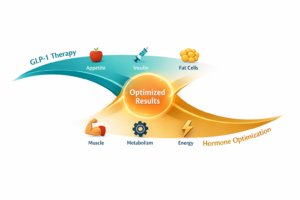
When both hormonal deficiency and excess body weight are present, treating only one problem leaves the other untreated. This is where combining GLP-1 and hormone replacement therapy becomes genuinely powerful.
Groundbreaking research presented in 2025 found that women using tirzepatide and hormone replacement therapy together lost significantly more weight and maintained those results more effectively than women using a GLP-1 medication alone. The proposed mechanism: restoring estrogen levels improves the body’s sensitivity to GLP-1 signaling itself, making the medication more effective.
Here’s how the combination of GLP-1 and hormone replacement therapy creates a compounding benefit:
1. Hormones protect muscle during GLP-1-driven weight loss. One of the most important — and underappreciated — risks of aggressive GLP-1 therapy is muscle loss. Rapid caloric restriction can cause the body to catabolize lean tissue along with fat. Testosterone (in men) and estrogen (in women) are potent signals to preserve and rebuild muscle. When hormones are optimized, your body is far better equipped to lose fat specifically rather than a mix of fat and muscle.
2. Hormone optimization improves insulin sensitivity, enhancing GLP-1 efficacy. GLP-1 medications work in part by improving insulin signaling. Testosterone and estrogen also independently improve insulin sensitivity. Together, the effect on glucose metabolism and fat mobilization is additive.
3. TRT raises resting metabolic rate by increasing lean mass. Every pound of muscle burns more calories at rest than a pound of fat. As TRT rebuilds lean body mass, it raises your resting metabolic rate (RMR) — meaning you burn more calories even when sedentary. GLP-1 medications reduce caloric intake; testosterone optimization increases caloric expenditure. This is a powerful combination.
4. Hormone therapy addresses the root cause; GLP-1 addresses the current burden. Think of it this way: GLP-1 medications are highly effective at reducing body fat and improving metabolic markers now. Hormone replacement therapy corrects the underlying deficiency that was making weight management so difficult to begin with. Together, they work on both the symptom and the cause.
When It Makes Clinical Sense to Combine GLP-1 and Hormone Replacement Therapy
Not every patient needs both therapies. But combining GLP-1 and hormone replacement therapy — whether HRT or TRT — is often appropriate when:
- You’re a perimenopausal or menopausal woman with weight gain concentrated around the abdomen, worsening insulin resistance, and declining energy — especially if GLP-1 therapy alone hasn’t produced the results you expected
- You’re a man with confirmed low testosterone who needs to lose weight — TRT helps preserve and rebuild the muscle that GLP-1-driven calorie restriction would otherwise deplete
- Your DEXA body composition scan shows excessive fat mass with low lean muscle mass, indicating that fat loss alone isn’t sufficient — you also need to rebuild body composition
- Your labs show insulin resistance alongside hormone deficiency, a combination that responds particularly well to dual therapy
- You’ve been on GLP-1 therapy for several months with diminishing results, and hormone levels haven’t been evaluated as a contributing factor
- Your RMR testing reveals a suppressed resting metabolic rate, often associated with low thyroid or sex hormone levels
At Connexus Clinic, we use DEXA body composition scanning, resting metabolic rate (RMR) testing, VO2 Max assessment, and advanced lab panels to evaluate all of these variables before making treatment recommendations. This data-driven approach means we’re not guessing — we’re building a protocol around your actual physiology.
When You Should NOT Combine These Therapies (Or Proceed with Caution)
Equally important is knowing when combining GLP-1 and hormone replacement therapy is contraindicated or requires careful monitoring.
Absolute or strong contraindications to HRT/TRT (in which a GLP-1 alone may be the right choice):
- Active hormone-sensitive cancers — Estrogen-receptor positive breast cancer, prostate cancer, or other hormone-sensitive malignancies are contraindications to sex hormone therapy. GLP-1s may still be appropriate with oncology team coordination.
- Active or high-risk thromboembolic disease — Oral estrogen formulations can increase clotting risk. Patients with a history of DVT, pulmonary embolism, or clotting disorders should discuss risks carefully; transdermal delivery significantly mitigates this risk.
- Undiagnosed abnormal uterine bleeding — Should be evaluated before initiating estrogen/progesterone therapy.
- Uncontrolled polycythemia (elevated hematocrit) — Can occur with TRT; requires monitoring and dose adjustment.
Situations requiring caution before combining:
- Hormone levels haven’t been tested — Adding HRT or TRT to a GLP-1 protocol without confirmed deficiency provides little benefit and adds unnecessary risk. Lab work comes first, always. Our advanced lab work panels are specifically designed to reveal these deficiencies.
- Hormone levels are actually normal — If your testosterone or estrogen levels are within optimal ranges, adding replacement therapy won’t enhance weight loss and may cause side effects.
- Oral HRT with GLP-1 medications — Because GLP-1s slow gastric emptying, they can alter the absorption of oral medications, including oral estrogen. Transdermal (patch, gel, pellet) or injectable delivery of hormones is generally preferred for patients on GLP-1 therapy.
- Uncontrolled cardiovascular disease — Requires individualized assessment before initiating either therapy.
- Pregnancy or breastfeeding — Both therapies are contraindicated.
This is precisely why a thorough evaluation — not a one-size-fits-all protocol — is essential.
The Role of Advanced Testing in Getting GLP-1 and Hormone Replacement Therapy Right
The difference between a treatment protocol that transforms your health and one that falls flat often comes down to how much you know about your baseline physiology before you start.
At Telomere-Connexus Clinic in Mobile, AL, our approach to medical weight loss and hormone optimization is built around diagnostics that most clinics simply don’t offer:
DEXA Body Composition Scan — The gold standard for distinguishing fat mass from lean muscle mass, and for tracking changes in body composition over time. Weight on a scale tells you almost nothing; DEXA tells you everything.
Resting Metabolic Rate (RMR) Testing — Measures exactly how many calories your body burns at rest. This is foundational data for building a weight loss plan that works with your metabolism rather than against it, and it’s essential for identifying metabolically suppressed patients who need hormonal support.
VO2 Max Testing — Measures cardiovascular and aerobic capacity, a powerful predictor of longevity. Combined with RMR, it gives us a complete picture of your metabolic fitness — and serves as a benchmark to measure your progress over time.
Advanced Lab Work — Goes far beyond a basic metabolic panel to assess sex hormone levels (total and free testosterone, estradiol, SHBG, progesterone), thyroid function, inflammatory markers, insulin resistance indicators, lipid fractionation, and more.
These are the same tests used by longevity medicine specialists — and they’re available right here in Mobile, AL.
Your Next Step: A Protocol Built Around Your Biology
GLP-1 and hormone replacement therapy are not competing approaches. For the right patient, they are complementary pillars of a comprehensive metabolic health strategy — one that addresses both the immediate burden of excess body fat and the underlying hormonal environment that made it so hard to lose in the first place.
Whether you’re in the early stages of considering medical weight loss, already on a GLP-1 and wondering why you’ve plateaued, or on HRT and still struggling with body composition — Connexus Clinic has the diagnostic tools and clinical expertise to help you find out exactly what your body needs.
Ready to stop guessing and start knowing? Contact Connexus Clinic in Mobile, AL today to schedule your comprehensive metabolic evaluation. Our team will assess your hormone levels, metabolic rate, body composition, and cardiovascular fitness — and build a protocol designed specifically for you.
Connexus Clinic offers medical weight loss, hormone replacement therapy (TRT and HRT), advanced lab work and diagnostic testing, DEXA body composition scans, VO2 Max testing, and resting metabolic rate assessment in Mobile, Alabama.